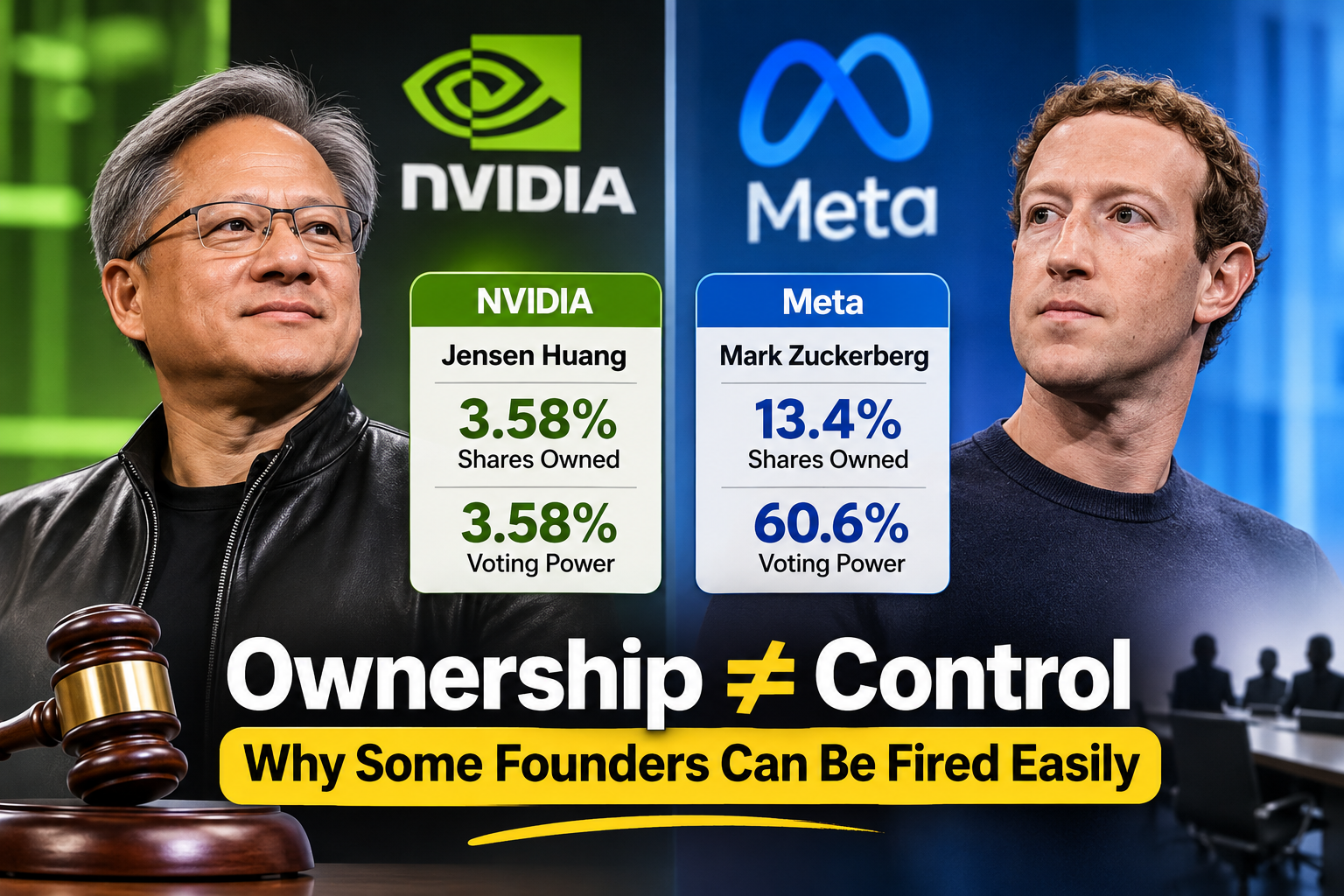
Except you’ve been off social media in the last three weeks, you’ve probably come across the news that rocked the headlines in the last couple of days: Jensen Huang, the founder and CEO of NVIDIA, resigned and was subsequently reinstated by the company.
One question I’ve heard from a few friends and family members alike is: How could they force him to resign? It’s his company!
Well, Jensen isn’t the first person to be removed from a company he co-founded. History is littered with stories of founders who were fired or forced out of their companies and, in some cases, subsequently returned. Steve Jobs of Apple, Sam Altman of OpenAI, and Travis Kalanick of Uber, just to name a few.
Last week, I wrote about stock options and what they mean for employees. Today, I’ll talk about share types and what they mean for founders. In this article, I’ll attempt to explain why some founders can be removed by their boards more easily, while others, like Mark Zuckerberg of Meta, are much harder to oust.
Share structure and voting rights
From a layman’s point of view, the number of shares you own in a business determines the power you wield in that business. This is generally true when all shares carry equal voting rights.
For example, if you own 51% of a company’s shares and each share carries one vote, you also control 51% of the voting rights. This gives you more power and authority than someone who owns the remaining 49%. That 2% difference in shareholding and voting power can make all the difference.
In the case of NVIDIA, the company has one principal class of publicly traded shares: common stock. These shares carry a 1-to-1 voting structure. This means each share carries one voting right.
In practical terms: If you own 100 NVIDIA shares, you have 100 votes.
Jensen Huang, according to NVIDIA’s 2026 annual report, owns approximately 3.58% of the company’s shares. This translates to 870,604,104 NVIDIA common shares. Since each share carries one vote, he has 870,604,104 votes. You get the idea now.
Vanguard and BlackRock, on the other hand, report beneficial ownership of approximately 7.31% and 7.43% of NVIDIA respectively. This translates to about 1,777,408,252 shares and 1,805,935,550 shares respectively.
However, beneficial ownership and the power to vote every share are not necessarily the same thing. For example, Vanguard reported voting power over approximately 238.9 million shares, despite having dispositive power over approximately 1.777 billion shares.
Going by the 1-to-1 structure of NVIDIA’s shares and voting rights, Jensen doesn’t have that much voting power relative to these institutional investors. This is an important distinction when considering how much control a founder actually has over a company.
Let’s look at Meta, another amazing company.
Meta has a different share structure consisting of multiple share classes: Class A, Class B and, following its approved recapitalisation, Class C.
Meta’s Class A shares are publicly traded and carry a 1-to-1 voting structure. This means each share carries one voting right.
Class B shares, on the other hand, are not publicly traded. They are predominantly held by Mark Zuckerberg and entities associated with him. These shares carry a 1-to-10 voting structure. Meaning, each share carries ten voting rights, giving them ten times the voting power of Class A shares.
This explains why Zuckerberg has majority voting control and cannot easily be ousted through an ordinary shareholder vote.
Meta’s new Class C shares are designed to carry no voting rights. The company intends to use them for employee compensation, raising capital, potential acquisitions and other corporate purposes without diluting the voting power of existing shareholders. The new share class is scheduled to take effect on January 19, 2027.
Let’s break it down
| Share Class | Shareholder | Voting Right |
|---|---|---|
| Class A | Public Investors | 1 vote |
| Class B | Mark Zuckerberg | 10 votes |
| Class C | E.g Employees | 0 vote |
Let’s imagine Meta had 100 shares
| Shareholder | Share Type | Shares | Votes |
|---|---|---|---|
| Public Investor | Class A | 80 | 80 |
| Mark Zuckerberg | Class B | 20 | 200 |
| Total | 100 | 280 |
Although Zuckerberg owns only 20% of the shares in this simplified example, he controls 71.4% of the votes — (200 / 280) × 100.
Conclusion
According to Meta’s 2026 SEC filing, as of October 1, 2026, Zuckerberg owns:
- 341,215,148 Class B shares.
- 1,220,703 Class A shares.
- Voting ownership: approximately 60.6% of Meta’s total voting power.
- Economic ownership: approximately 13.4% of the company.
In other words, his influence over the company is substantially greater than his economic ownership percentage.
This is why ordinary investors cannot simply organise themselves and vote him out. He has enough voting power to determine the outcome of shareholder votes, including the election of directors.
Jensen, on the other hand, does not enjoy the same level of voting control at NVIDIA. Although he owns a substantial number of shares, his voting power is proportional to his shareholding. NVIDIA’s board can therefore remove him as CEO without needing to overcome the kind of founder-controlled voting structure that exists at Meta.
And that, in a nutshell, is the difference between owning a company and controlling it.
I'll love to hear from you
Do you want to say hello? Email me - celestineomin@gmail.com
I tweet at @cyberomin
If you enjoyed this post, please consider sharing it. comments powered by Disqus