Ownership is the state, fact, or legal right of possessing and controlling property, whether tangible (like land or a car) or intangible (like a copyright or patent). It can also refer to a group of owners or to taking personal responsibility for a task or problem.
The definition above is from the Merriam-Webster dictionary, and it’s self-explanatory.
When you join a new company, especially an early-stage startup, part of your compensation may come in the form of equity or equity-related benefits. Ownership arrangements vary, and they’re not all created equal.
There are different ways to participate in a company’s ownership, but two common forms of employee equity compensation are stock options and shares (equity).
So, what’s the difference, and why does it matter?
Let’s look at the case of Etim, a brilliant middle-manager and finance professional.
Two months ago, he received a random LinkedIn message from a recruiter at XYZ Inc. The recruiter pitched him what she considered a once-in-a-lifetime opportunity: a team lead position, meaningful work, high impact, brilliant colleagues, and a possible financial windfall.
Etim, though not actively looking for a change, was intrigued. He took the initial introductory meeting, followed by three other meetings, the last of which was with the founder.
Everyone liked him. He was a rockstar, a round peg in a round hole. Then, he received the offer below:
- Base Salary: NXX,XXX,XXX
- Stock Options: 2,000 units, with an estimated underlying share value of $100,000 (N140,000,000), subject to a four-year vesting schedule and a one-year cliff.
- Strike Price: $10/share.
- Exercise Window: 90 days after leaving the company.
- Other Benefits: Health insurance and annual bonus.
Etim was excited. His new base salary was 40% higher than his previous one, and he also stood a chance of benefiting from the company’s future growth. Sweet deal, or so he thought.
Now, let’s discuss the stock options component of this offer and what it actually means.
2,000 units: This is the number of stock options granted to Etim. It doesn’t mean he immediately owns 2,000 shares. Rather, he has the right to purchase up to 2,000 shares, subject to the vesting conditions.
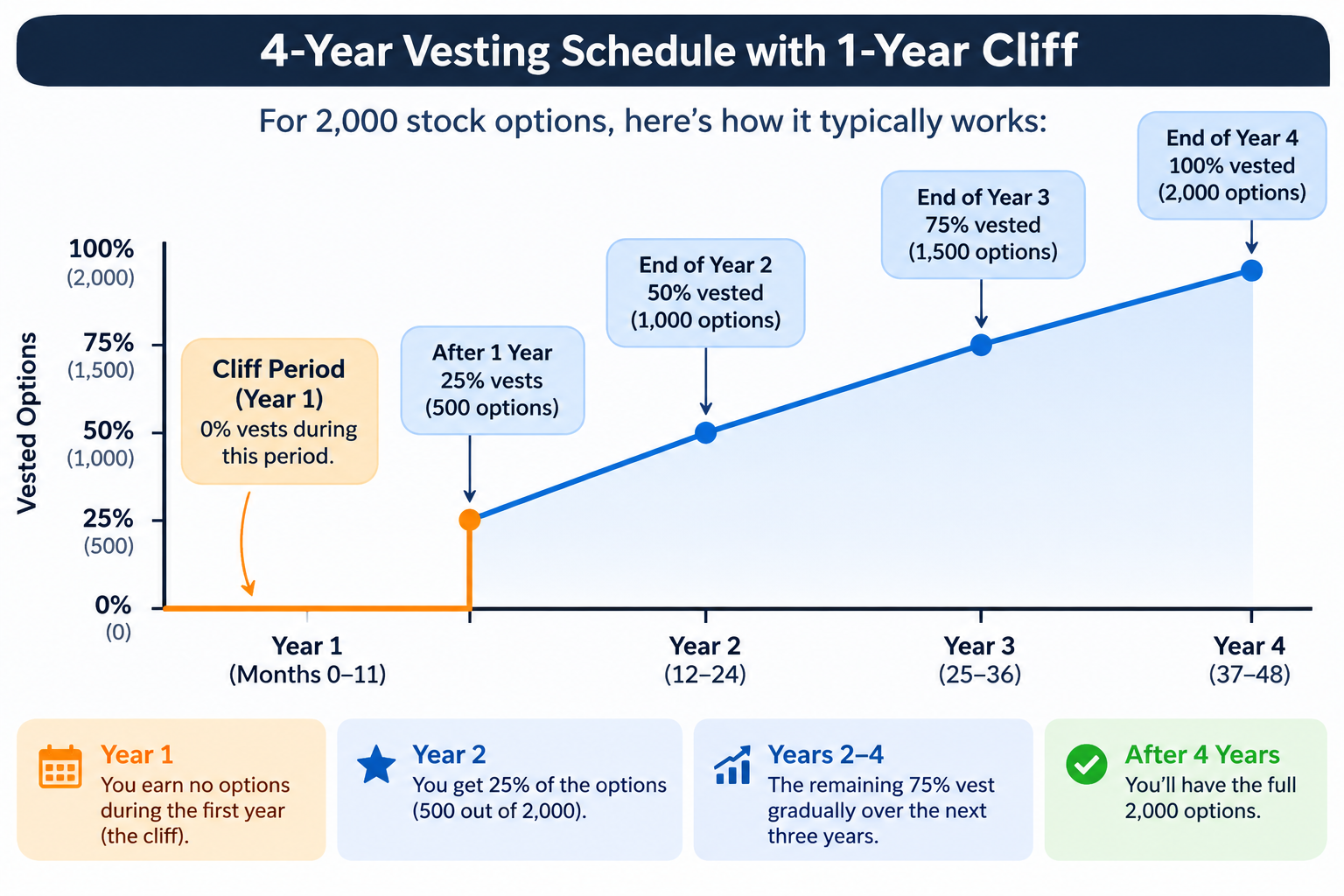
Four-year vesting schedule: This is the period over which Etim earns the right to exercise his stock options. He doesn’t get access to all 2,000 options immediately. He earns them over time, provided he meets the vesting conditions.
One-year cliff: This is the waiting period at the beginning of the vesting schedule during which 0% of the options vest.
If he leaves or is terminated before the cliff ends, he typically forfeits all his unvested options.
In a standard four-year vesting arrangement with a one-year cliff, 25% of the options vest immediately after the first 12 months. The remaining 75% typically vest monthly or quarterly over the next three years.
In Etim’s case, that’s 500 options after the first year, followed by the remaining 1,500 over the next three years.
Strike price: This is the fixed price per share at which the option holder, Etim, can purchase the company’s shares when he decides to exercise his vested options.
Exercise window: This is the period during which Etim can exercise his vested options by paying the agreed strike price.
A 90-day post-termination exercise window means that if he leaves the company or is terminated, he typically has 90 days to exercise his vested options. If he doesn’t, they expire and he loses the right to purchase those shares. The actual terms depend on the company’s stock option plan and grant agreement.
For example, if Etim leaves at the end of his third year, 75% of his options (1,500) would have vested. At a strike price of $10 per share, he would need $15,000 to exercise them within the 90-day window.
If he can’t come up with the money within that period, he could lose the opportunity to exercise those options.
So, what does this mean for Etim?
The fact that Etim received 2,000 stock options with an estimated underlying share value of $100,000 doesn’t automatically mean he owns $100,000 worth of shares or that he’ll receive $100,000 after four years.
He doesn’t.
What he has is an opportunity to purchase up to 2,000 shares of XYZ Inc. at $10 per share, provided he satisfies the vesting conditions and exercises his options.
And even after exercising them, there’s no guarantee he’ll be able to sell those shares or make a profit. The company could lose value, remain private for years, or never provide an opportunity for him to sell.
If he voluntarily leaves or is fired before completing the four-year vesting period, he’ll typically forfeit the unvested portion of his options. If he leaves before his first anniversary, he won’t get any vested options, even if he has the money to exercise them.
The illustration above is quite simplistic, but it gives you a general idea of how stock options work.
So, how can Etim protect himself and negotiate a better deal?
For starters, Etim can negotiate the post-termination exercise window. Instead of 90 days, he could negotiate for three years.
This means that if he leaves or is fired, he has three years to come up with the money to exercise his vested options, assuming the company allows this arrangement and the options haven’t otherwise expired.
This also gives him the opportunity to see how the company performs after his exit.
If the company does well, gets a higher valuation, and the value of his vested shares increases, exercising at $10 per share could turn out to be a great deal.
But what happens if XYZ is sold at his third anniversary and the new owner decides to fire him?
Well, based on his original vesting agreement, only 75% of his options would have vested. The remaining 25% would still be unvested and could be forfeited, depending on what happens to the options during the acquisition.
To protect himself, Etim can negotiate a clause that says if the company is sold and the new owner terminates his employment without cause (or he resigns for a qualifying reason) within an agreed period after the acquisition, his remaining unvested options will immediately vest.
This is typically known as double-trigger acceleration.
The first trigger is the sale or change of control of the company. The second is a qualifying termination of employment following that event.
With this provision in place, Etim has some protection against losing the unvested portion of his options simply because the company changes hands and the new owner decides he is no longer needed.
It’s worth noting that double-trigger acceleration doesn’t automatically come with every stock option grant. It’s something worth negotiating, especially for senior hires.
Stock options are commonly used as part of employee compensation packages, particularly in startups.
Equity (shares), on the other hand, works slightly differently.
When a company issues shares directly to you, you’re generally becoming a shareholder once the shares are validly issued or allotted in accordance with the applicable legal and company requirements.
Unlike stock options, you don’t need to exercise a right to purchase those shares later if you’ve already paid for them and they’ve been issued to you.
However, this doesn’t mean shares are always free of conditions.
Shares can also be subject to vesting schedules, restrictions on transfers, buyback arrangements, and other conditions. This is particularly common with founders and early employees.
The important distinction is that with stock options, you have the right to buy shares in the future, while with issued equity, you already hold shares, subject to the terms governing them.
So, the next time you get an offer that includes ownership or equity compensation, read the fine print and understand exactly what you’re committing to before putting pen to paper.
I'll love to hear from you
Do you want to say hello? Email me - celestineomin@gmail.com
I tweet at @cyberomin
If you enjoyed this post, please consider sharing it. comments powered by Disqus