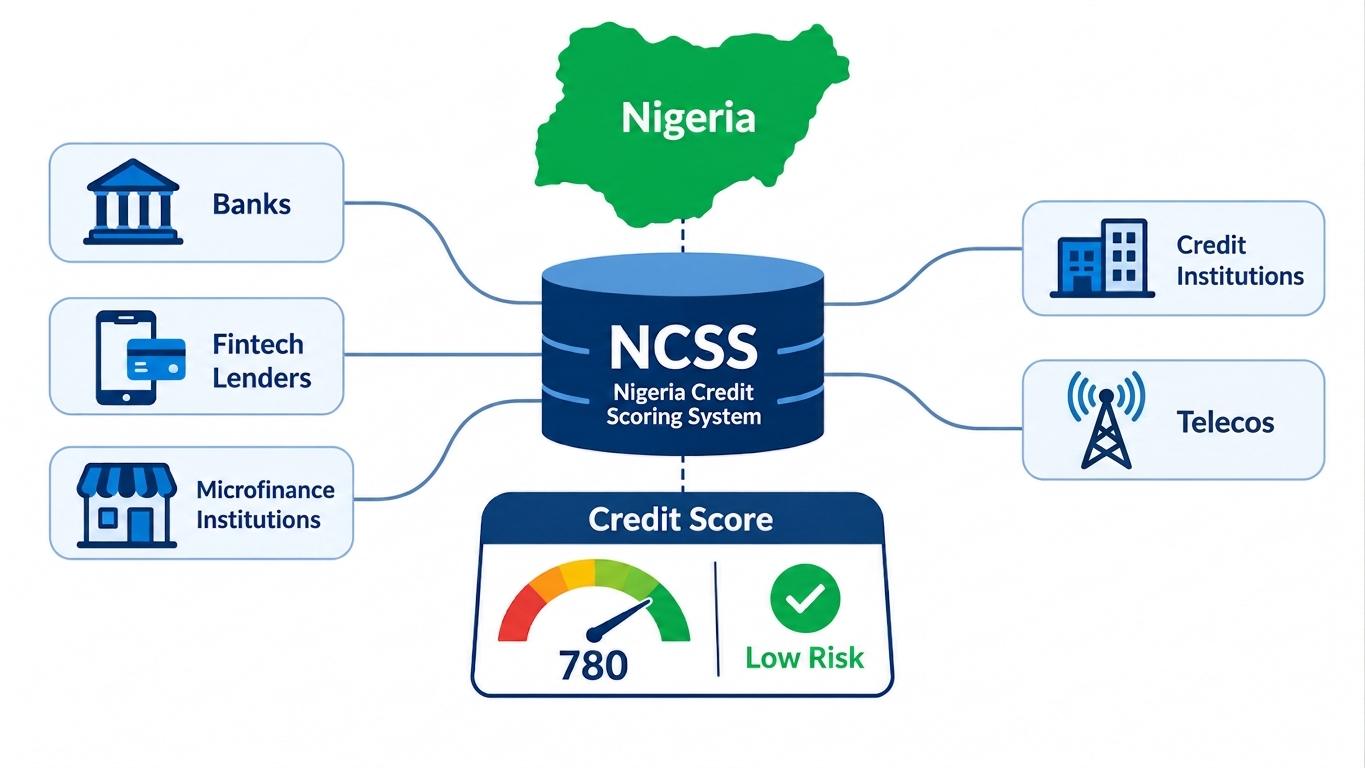
NIBSS, but for the credit ecosystem.
In an earlier post, I wrote about my previous company, Klump. I talked about the painful challenges of building a credit based business in a market like Nigeria.
In this post, I will discuss the challenges associated with eligibility checks and propose what I consider a possible solution.
Credit companies in Nigeria face a number of challenges, chief among them being loan collection and access to accurate data for eligibility checks. For a lender, eligibility checks aren’t a one-time exercise. They are recurrent. The very fact that a borrower was eligible a couple of months ago doesn’t necessarily mean they will be eligible this today.
Let’s talk about collection:
For loan collection, a typical user is asked to leave a card on file. However, a card, in itself, isn’t foolproof.
Here’s a typical sequence. A user adds a card at checkout. The card is tokenized by a payment processor, the credit company stores the credit company stores the card token and uses it to charge the borrower on the relevant due dates throughout the loan tenor.
While this should work in theory, the process comes with a number of problems:
- The borrower may decide not to fund the account again. We can see this in our everyday lives; people will typically ask loved ones not to send money to a particular account as that account isn’t “working”
- Card expiration. For example, if a loan has a tenor of six months and the card on file expires after three months, there isn’t much the lender can do. You have to pray and hope the borrower will not ignore your micro nudge to add a new card.
- Blocked card. A user might just block a card or mark it as stolen. When this happens, there isn’t much the lender can do.
The issues above can be solved by Direct Debit.
So what exactly is a Direct Debit?
A Direct Debit is an automated payment arrangement where a customer authorizes a business or organization to withdraw recurring fixed or variable amounts directly from their bank account.
The user gives the organization an authorization mandate during the loan booking process, which solves the collection problem.
The beautiful thing about Direct Debit is that the last 2 issues listed above are non-issues here. However, the first issue on the list persists. To solve this, lenders will need access to GSI (Global Standing Instruction) — A system that allows a lender to recover a loan and its accrued interest from any bank account, irrespective of where the account is domiciled, that is linked to the borrower’s identity, such as their BVN.
With GSI, the collection problem has been solved. But GSI isn’t open to all lenders. As at today, only DMB can access it.
Now, the elephant in the room is the credit check at the point of underwriting. During the underwriting process, a credit check will look for a few signals:
- Has this user ever gotten a loan?
- This is to solve for those new to credit
- Does this user owe a loan?
- Is this an active loan - a loan that has a valid tenor
- Is this a defaulted loan - a loan that has gone into default
- Does this user have an active loan?
- If the user has an active loan, is the user making the required repayments?
This is how I imagine we will fix this.
A central repository where all fintech companies and Deposit Money Banks (DMBs) submit their loan data. This will happen in real time, with no batch processing.
A user approaches an institution for a loan. The institution collects the user’s identifier, in this case, their BVN, and runs an eligibility check. If the check is successful, the loan is disbursed, its details are stored in the central repository, and the information is made available to other lenders instantaneously.
As the user pays off their loan obligation, either manually or through an automated process, the lender is obligated to update the loan’s status until the tenor expires.
What’s the incentive here? A unified repository for all interested parties, with the major value proposition being lower NPLs (non-performing loans) for all parties with a vested interest.
Borrowing history check
To check the loan status of a user with the BVN 12345678, send a GET request as follows
Loan status:
curl -G "/v1/loans" \
  -H "Authorization: Bearer YOUR_API_TOKEN" \f
  -d "bvn=12345678"
Response:
{
 "fname": "John",
 "lname": "Doe",
 "date_of_birth": "1996-03-12",
 "loans": [
 {
  "id": "xyqabc",
  "principal": 100000,
  "interest": 15000,
  "rate": 4.5,
  "booked_date": "2026-01-01",
  "expected_closed_date": "2026-04-01",
  "state": "not_paid",
  "status": "default",
  "currency": "NGN",
  "institution_code": "CB00101"
 },
 {
  "id": "xyzabc",
  "principal": 100000,
  "interest": 15000,
  "rate": 4.5,
  "booked_date": "2026-01-01",
  "expected_closed_date": "2026-04-01",
  "state": "paid",
  "status": "closed",
  "currency": "NGN",
  "institutuon_code": "FT0101"
 }]
}
The response above shows that this individual has two loans; one was paid off and the other went into default. This is the entire credit history of the user.
If an institution wants to narrow its search to a specific loan and view its details, it can make a request like this:
curl -G "/v1/loans/{id}/status" \
  -H "Authorization: Bearer YOUR_API_TOKEN" \
  -d "bvn=12345678"
The request above returns information about a single loan, as shown below:
{
 "principal": 100000,
 "interest": 15000,
 "rate": 3.5,
 "tenor": 3,
 "booked_date": "2026-01-01",
 "repayment_start_date": "2026-02-01",
 "currency": "NGN",
 "institution_code": "CB00101",
 "status": "on_going",
 "state": "paid",
 "bio_data": {
  "fname": "John",
  "lname": "Doe",
  "date_of_birth": "1996-03-12"
 },
 "repayments": [
  {
    "amount": 38333.33,
    "due_date": "2026-02-01",
    "state": "paid"
  },
  {
    "amount": 38333.33,
    "due_date": "2026-03-01",
    "state": "paid"
  },
  {
    "amount": 38333.33,
    "due_date": "2026-04-01",
    "state": "not_paid"
  }]
}
The institution_code represents the institution that issued the loan. The code will always be alphanumeric, consisting of an alphabetic prefix followed by five digits. CB represents a commercial bank, MFB represents a microfinance bank, and FT represents a fintech company..
The loan status can either be on_going, which signifing that the loan is still active or default, which signifies that the loan has exceeded its tenor without being fully repaid.
The loan state can be either paid, indicating that the loan has been fully repaid, or not_paid indicating that the loan has not been fully repaid. These two fields are necessary as a loan can have a status of on_going while its state is paid.
With the response above, a lender, whether new or existing, can easily determine that the user has an existing loan with a commercial bank, along with its repayment history.
Booking a loan
When booking a loan, the lender sends a POST request as follows:
curl -X POST /v1/loan-status \
  -H "Content-Type: application/json" \
  -H "Authorization: Bearer YOUR_API_TOKEN" \
  -d '{"bvn": "12345678", "principal": 100000, "rate": 3.5, "repayment_start_date": "2026-02-01", "currency": "NGN", "tenor": 3}'
The borrower’s bvn, the loan’s principal, rate rate, repayment start date repayment_start_date, loan currency and the loan tenor. The repayment_start_date is important because most institutions might offer a moratorium to their customers based on a special arrangement.
Mechanics: how this will work
It goes without saying that the system described above will only be available to licensed institutions. Before a lender can access a user’s lending history, it will need a virtual token to spend. Tokens are earned every time a lender posts new loan information or updates an existing loan record.
Every new loan booked earns the lender 10 tokens. Every subsequent loan update earns the lender another 5 tokens. So, a loan with a three months tenor will earn the lender a total of 25 tokens. The lender spends 15 tokens each time it attempts to access a user’s lending profile.
If a lender runs out of tokens, it can purchase additional tokens with real money. For example, N100 gives them access to 1,000 tokens. You get the idea. This system becomes a win-win for every participant.
While the above system is a good starting point, I think we can take this a step further.
Calculating a borrower’s credit score
Now, having a central repository where all lenders can see a borrower’s lending history is great, but I think we can take this a step further.
What if, instead of every lender having to interpret a borrower’s lending history independently, the system could calculate a credit score for that borrower?
Think about it. If a borrower has taken loans from three different institutions, the repository already has information about those loans, their repayment schedules, outstanding balances and repayment history. We should be able to use this information to derive a reasonably reliable picture of that borrower’s creditworthiness.
The idea isn’t particularly complicated. We need to agree on the signals that matter and how much weight each signal should carry.
For a start, I would use a scoring system that ranges from 300 to 850, where 850 represents the lowest estimated credit risk.
I’d break the calculation into five components:
1. Repayment behaviour (40%)
This is arguably the most important signal.
Does the borrower consistently repay their loans when due? Have they missed instalments? When they miss a payment, how long does it take them to make good on that obligation?
I would calculate this using the proportion of scheduled repayments made on or before their due dates, giving more importance to recent repayment behaviour.
A borrower who has consistently paid their loans over the last six months should have a better repayment score than someone whose recent repayment history is characterised by missed payments, even if they had a good repayment record three years ago.
2. Delinquency and default history (25%)
Missing a repayment isn’t necessarily the same as defaulting on a loan.
A borrower who misses a repayment by five days shouldn’t be treated the same way as someone who has failed to service a loan for six months.
I’d introduce a delinquency classification based on days past due (DPD).
For example:
| Days Past Due | Severity |
|---|---|
| 0 days | No delinquency |
| 1–30 days | Minor |
| 31–60 days | Moderate |
| 61–90 days | Serious |
| 91–120 days | Severe |
| Above 120 days | Critical |
The system should also consider whether the borrower eventually made good on the obligation. A historical delinquency that has been fully resolved shouldn’t carry the same weight as an outstanding default.
3. Existing debt exposure (15%)
Someone can have an excellent repayment history and still be over-leveraged.
For example, imagine someone earning N500,000 monthly who already has loan repayments of N200,000 across two institutions.
If another institution gives this person a loan with a monthly repayment of N150,000, their total monthly debt obligation becomes N350,000.
That’s 70% of their monthly income.
This is where the repository becomes particularly useful. Instead of a lender looking at only the loans it has issued, it can see the borrower’s aggregate outstanding obligations across participating institutions.
I’d use a debt service ratio (DSR) to measure this:
DSR = (Total Monthly Debt Obligations / Verified Monthly Income) × 100
The higher the ratio, the more pressure the borrower is likely to experience when servicing additional debt.
4. Credit history and consistency (10%)
How long has this individual been participating in the credit ecosystem?
Someone who has maintained a consistent repayment record for five years provides more evidence of their credit behaviour than someone who has only taken their first loan three months ago.
I would consider the length of the observed credit history and the consistency of repayment over that period.
One important distinction here: someone who has never taken a loan shouldn’t automatically be considered a bad borrower. They simply have no established credit history.
The system should distinguish between a borrower with no credit history and someone with a history of poor repayment.
5. Recent credit activity (10%)
How frequently is this borrower taking on new financial obligations?
For example, someone who has taken four loans from different institutions within the last 30 days might require additional scrutiny.
The system should look at the number of recently originated loans, the growth in outstanding balances and how these obligations compare with the borrower’s repayment capacity.
This is particularly important because the central repository makes it possible to identify borrowing activities that an individual lender might otherwise not see.
Putting the numbers together
Each of these five components produces a score between 0 and 100.
I’d then combine them using the following formula:
Credit Score = 300 + 5.5 × (0.40R + 0.25D + 0.15E + 0.10H + 0.10A)
Where:
- R = Repayment behaviour score
- D = Delinquency/default score
- E = Existing debt exposure score
- H = Credit history score
- A = Recent credit activity score
- 5.5 = Multiplier to scale the score to a range of 300–850. It’s gotten by dividing the range of the score (850 - 300 = 550) by the maximum possible weighted score (100).
- 300 = The minimum score in the range.
The weights are initial assumptions that would need to be tested against actual repayment data from participating institutions.
Let’s use an example.
Imagine a borrower with the following profile:
| Component | Score | Weight |
|---|---|---|
| Repayment behaviour | 92 | 40% |
| Delinquency history | 85 | 25% |
| Debt exposure | 75 | 15% |
| Credit history | 60 | 10% |
| Recent credit activity | 80 | 10% |
The weighted score is 83.3.
Applying our formula:
Credit Score = 300 + (5.5 × 83.3)
Credit Score = 758
We can then classify borrowers into different risk categories:
| Credit Score | Risk Category |
|---|---|
| 800–850 | Very low risk |
| 740–799 | Low risk |
| 670–739 | Moderate risk |
| 580–669 | High risk |
| 300–579 | Very high risk |
These are proposed starting bands, not established regulatory thresholds. They would need to be validated against actual loan performance.
What happens when someone has never taken a loan?
This is an interesting one.
I don’t think someone who has never borrowed should automatically receive a poor credit score. That would defeat the purpose of creating an inclusive credit ecosystem.
For borrowers with limited credit history, the system should return a provisional score with a confidence indicator.
For instance, a borrower might have a score of 720 but a low confidence rating because the system has only three months of repayment history.
Another borrower might have a score of 720 with a high confidence rating because the system has five years of verified repayment data.
These are not necessarily equivalent from an underwriting perspective.
I’d therefore return two things whenever a lender queries a borrower:
- The borrower’s credit score.
- The confidence level of that score.
The bigger picture
I think this is where the real opportunity lies.
The repository shouldn’t just tell a lender whether someone has an outstanding loan. It should provide a continuously updated picture of that individual’s credit behaviour across the financial ecosystem.
A lender should be able to understand how much a borrower currently owes, how consistently they repay, whether their debt exposure is increasing and how they have performed across other institutions.
Of course, the scoring methodology would need to be tested against actual loan performance, and there would need to be mechanisms for correcting inaccurate records, protecting borrowers’ information and explaining how scores are derived.
I’d start with a transparent, rules-based model and gradually improve it as more repayment data becomes available.
The interesting thing is that the more institutions participate, the more useful the repository becomes. And the more useful the repository becomes, the better the credit decisions institutions can make.
We shouldn’t just be building a place where lenders share loan information. We should be building an infrastructure that helps the entire financial ecosystem make better credit decisions.
Policy
For this to work, the government will have to be the primary driver, with buy-in from every institution that intends to offer credit.
I'll love to hear from you
Do you want to say hello? Email me - celestineomin@gmail.com
I tweet at @cyberomin
If you enjoyed this post, please consider sharing it. comments powered by Disqus